
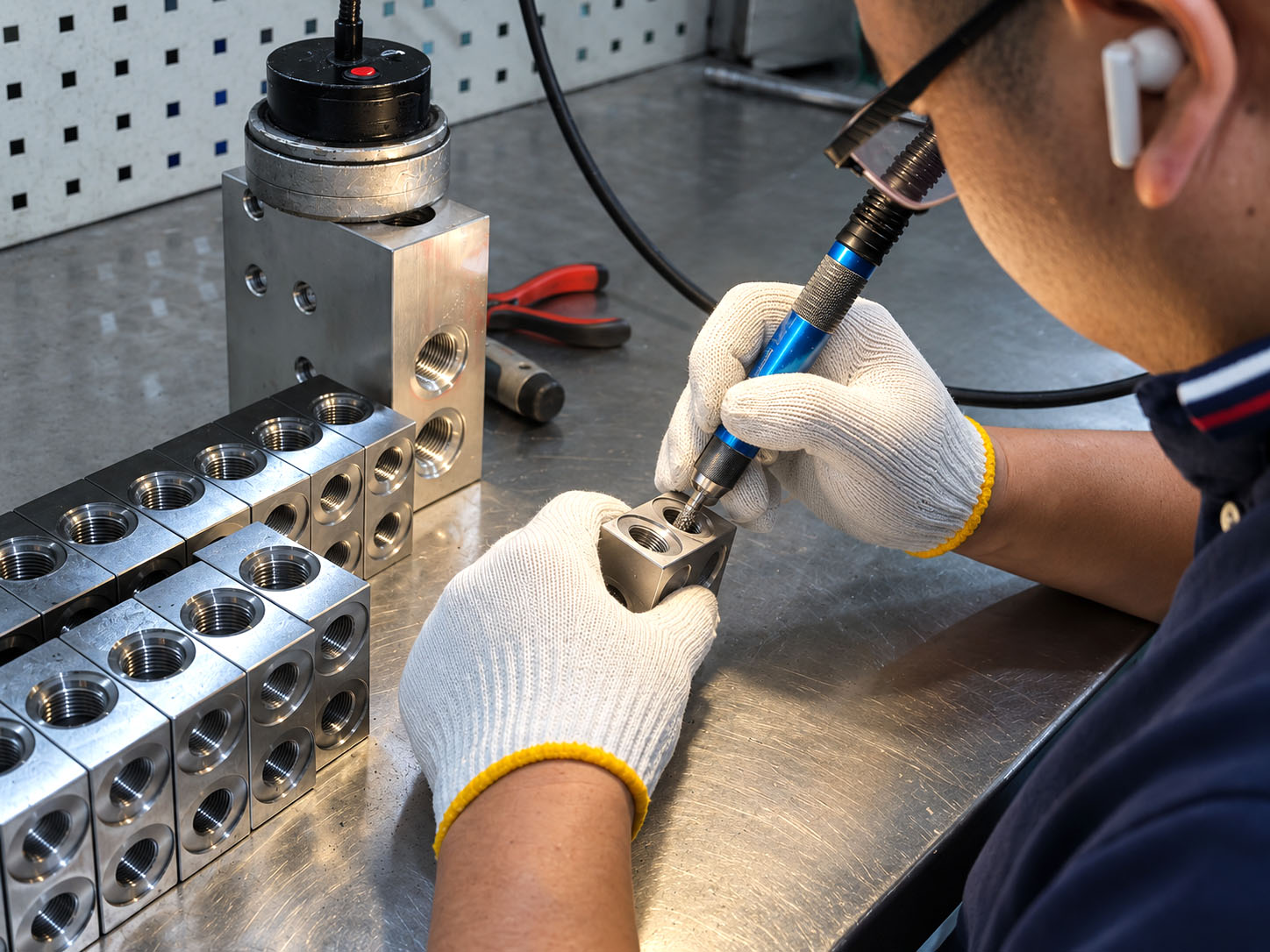
A clean-looking exterior does not reveal every internal risk
Residual burrs and machining particles inside a hydraulic manifold can interfere with valve movement or damage seals. The difficult locations are often below the visible surface: where passages intersect, threads end or a drilling reaches a cavity. Our process review starts with those features, rather than judging the part by its external appearance.
Cross-hole intersections
A drilling can leave an edge or burr where it breaks into another passage. The intersection needs attention during process planning because its location affects tool access, debris removal and the checks that can be performed.
Cavity edges and thread exits
These areas sit close to valve and sealing interfaces. Burr removal needs to preserve the drawing-defined geometry and surface requirements while addressing the unwanted edge.
Blind ends and deep intersections
Chips can remain in locations that are difficult to reach or observe. Cleaning access, drainage and the route out of the component need consideration alongside the drilling layout.
Plan internal access before the block reaches cleaning
Deburring and cleaning are part of the manufacturing route. We review passage connections, access openings, plug locations and operation order with the machining requirements. An intersection that is difficult to reach should be identified while process choices can still be discussed.
Connect geometry to the process
Review where passages meet and which openings give access. If the design restricts removal or inspection, raise the issue for engineering review before manufacturing release.
Account for later operations
Machining, surface treatment and assembly can change the condition of a component. The route must identify the required condition at handover and when subsequent cleaning or checks are needed.
For a repeat order, the controlled drawing and process requirements provide the common basis. A change to a passage, closure or finish may also change access and cleaning needs, even when the outside of the block looks unchanged.
Flow-path and cross-hole review Deep-hole and passage machiningRemove the burr while preserving the functional feature
Experienced manual deburring is an important part of Zhongwei’s work on small-batch, varied and complex manifold geometries. The task is to address the identified internal edges with an approach suited to their location, while preserving cavity steps, sealing surfaces and specified edge conditions.
Work from the risk locations
Cross-hole intersections, cavity edges, thread exits and blind ends guide the review. Deburring access and the applicable checks are considered for the actual component rather than assuming every internal feature is equally reachable.
Protect the intended geometry
Burr removal is not permission to enlarge a passage or change a sealing feature. Where an edge condition is unclear, clarify the requirement before using a finishing operation that could affect the functional geometry.
Removing an attached burr and removing loose particles are different tasks. Material released during deburring must also leave the block through the subsequent cleaning process. A visually tidy outer surface does not establish the condition of a hidden intersection.
Cavity features and machining controlsMatch the cleaning route to the passages and delivery condition
Our manifold work uses a connected cleaning process after machining and deburring. Zhongwei’s process experience includes ultrasonic cleaning and high-pressure water cleaning; the route used for a particular component depends on its geometry, material, finish and agreed requirements. A named cleaning method alone does not define the resulting cleanliness.
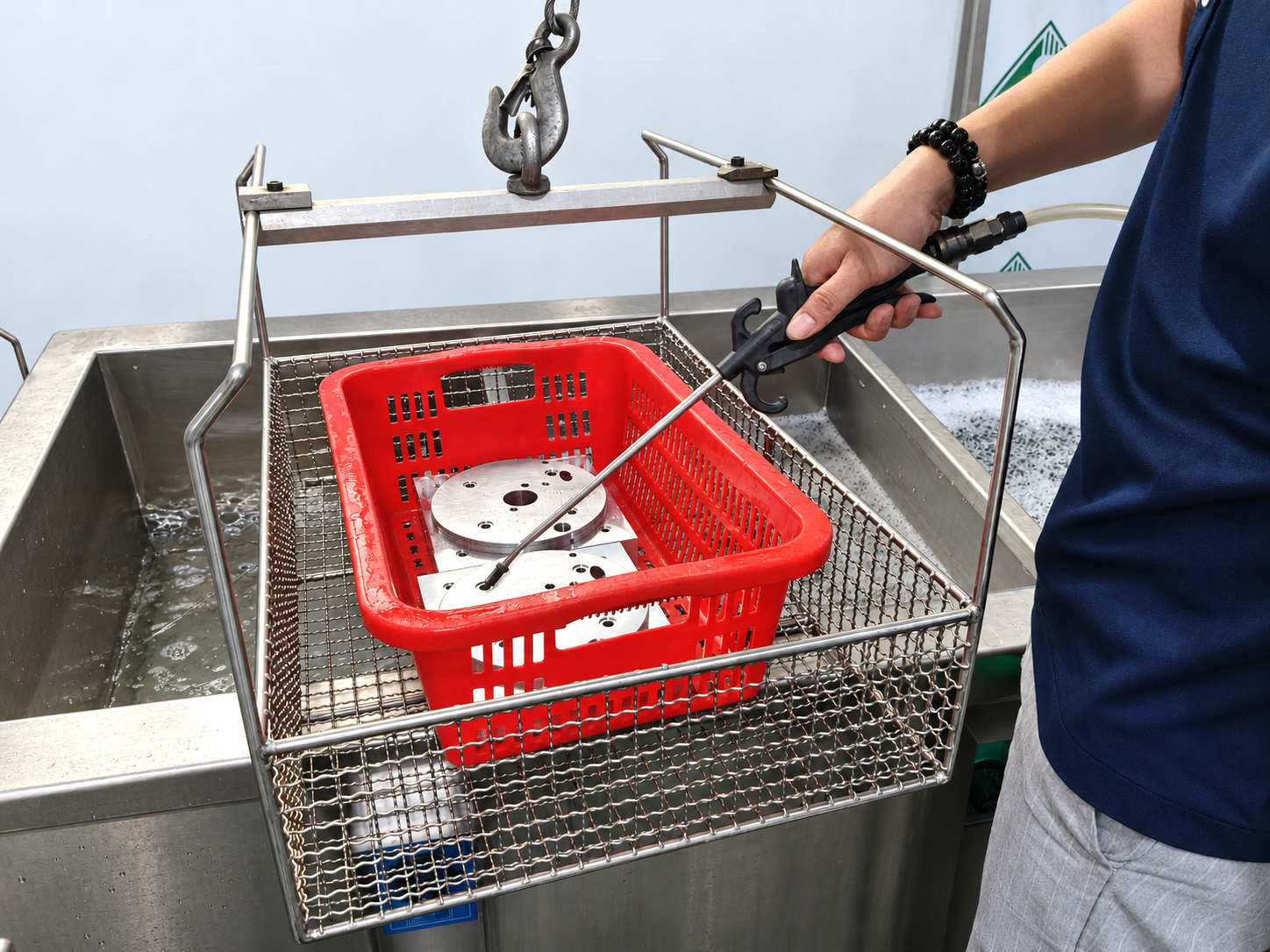
Cleaning reaches beyond the visible face
The cleaning equipment shown at the top of this page contains manifold components. This photograph shows a separate manual blow-off operation. They illustrate actual workshop resources and activities; neither photograph is a measurement of residual contamination.
Review how internal passages are reached and how loosened material can leave the component. Include the condition required after cleaning, any further processing, and the point at which the component will be checked or packed.
Temperature, fluid, pressure, duration and other process settings belong to the applicable process instructions. We do not use one advertised setting as a universal recipe for every material and cavity arrangement.
Preserve the result through handling and packaging
The work continues after cleaning. A manifold can be exposed again during handling, identification, storage or packing. Zhongwei’s internal control chain therefore includes clean handling and packaging, with the protection details agreed for the component and its next operation.
Define the condition before packing
Address drying and any required corrosion protection in relation to the material and downstream assembly. Identify whether residues or protective products are restricted by the customer’s requirements.
Protect openings and critical surfaces
Specify closure and surface-protection needs so packaging supports the intended delivery condition. Materials used around exposed passages and sealing surfaces should be considered as part of that plan.
Make the handover clear
Agree identification, packaging configuration and any storage or handling information needed by the receiving team. The packaging arrangement should allow the part to reach the next operation in its specified condition.
Q355B and GB 45 cylinder-end valve blocks intended for welding are supplied as machined parts immersed in a no-clean rust-preventive oil and packed in sealed, dust-protective PE bags, without plating, black oxide or phosphating. The specified oil supports welding without a separate oil-removal step, subject to compatibility with the agreed welding procedure.
Zhongwei uses approximately 3–6 months as an experience-based reference for this preservation route, subject to packaging and storage conditions. Dry storage helps maintain protection; moisture exposure, handling and damage to the bag or oil film can change the outcome. Agree the storage and transport requirements for the order rather than treating this reference as an unconditional rust-free period.
Customer feedback reported to Zhongwei describes parts protected with this oil and sealed in dust-protective PE bags that showed no rust after approximately one month of sea transport followed by more than one month in a warehouse. This is delivery experience for those conditions, not a controlled corrosion test or a guarantee for every shipment.
Weld-compatible preservation does not establish hydraulic-fluid or seal compatibility for later assembly. Identify any separate residue or fluid-compatibility requirements, and the condition required for component-cleanliness testing.
Oil-preserved cylinder-end delivery Surface-treatment management Documentation and traceabilitySeparate process control from a measured cleanliness result
Internal manufacturing control
Controlled deburring, cleaning, clean handling and packaging address contamination risks in the manufacturing route. Process photographs and visual checks provide context, but do not establish a numerical particle limit.
Formal component cleanliness testing
Where required, third-party testing can be arranged with SGS against ISO 16232 and a project-agreed specification. Agree the applicable method, part condition, sample scope, reporting basis and acceptance limits before testing.
A report applies to its identified part, sample and test scope. Component cleanliness verification is distinct from drawing-based material, dimensional, thread, roughness and burr checks, and from the cleanliness of operating fluid in an assembled system. Machined manifold blocks are normally supplied without pressure or functional testing. Material and design suitability are determined by the responsible design engineer for the operating conditions.
Third-party cleanliness verification How to specify component cleanlinessQuestions about internal cleanliness
Will cleaning alone remove internal burrs?
Burr removal and cleaning address different conditions. Attached burrs at intersections or feature edges need an appropriate deburring approach; cleaning then addresses loose particles and the required component condition. They should be planned as connected operations.
Can you check every hidden surface visually?
Visibility depends on the passage geometry and access. We review the available checks for the actual part and flag access limitations. Visual appearance alone cannot establish a quantified cleanliness requirement.
Is every manifold supplied with an ISO 16232 report?
No. Formal cleanliness testing and reporting are agreed for the project. Our internal deburring and cleaning process does not mean each block automatically receives a third-party report. State the sample scope and required acceptance evidence during enquiry.
Do all parts use the same cleaning and packaging process?
The route and delivery protection depend on material, finish, passage geometry and customer requirements. A steel part requiring corrosion protection may have different handover requirements from a component going directly into assembly.
What if we already have a particle contamination specification?
Send the specification, drawing revision, relevant surfaces or passages, required sample condition and acceptance limits. Include the extraction or test method and reporting requirements where defined, so process planning and any third-party testing can be discussed together.
Tell us what must be controlled at delivery
Send the manifold drawing or model, material and finish, quantities, and any known internal contamination concern. Mark the passages, cavities or intersections needing particular attention and identify the next operation after delivery.
For manufacturing review
Share any difficult access areas, proposed plugs or closures, downstream coating or assembly operations, and restrictions on protective residues or packaging.
For formal acceptance
Include the cleanliness specification, method and limits, sample or batch scope, required report and the stage at which acceptance applies. If those requirements are incomplete, identify what still needs to be agreed.