
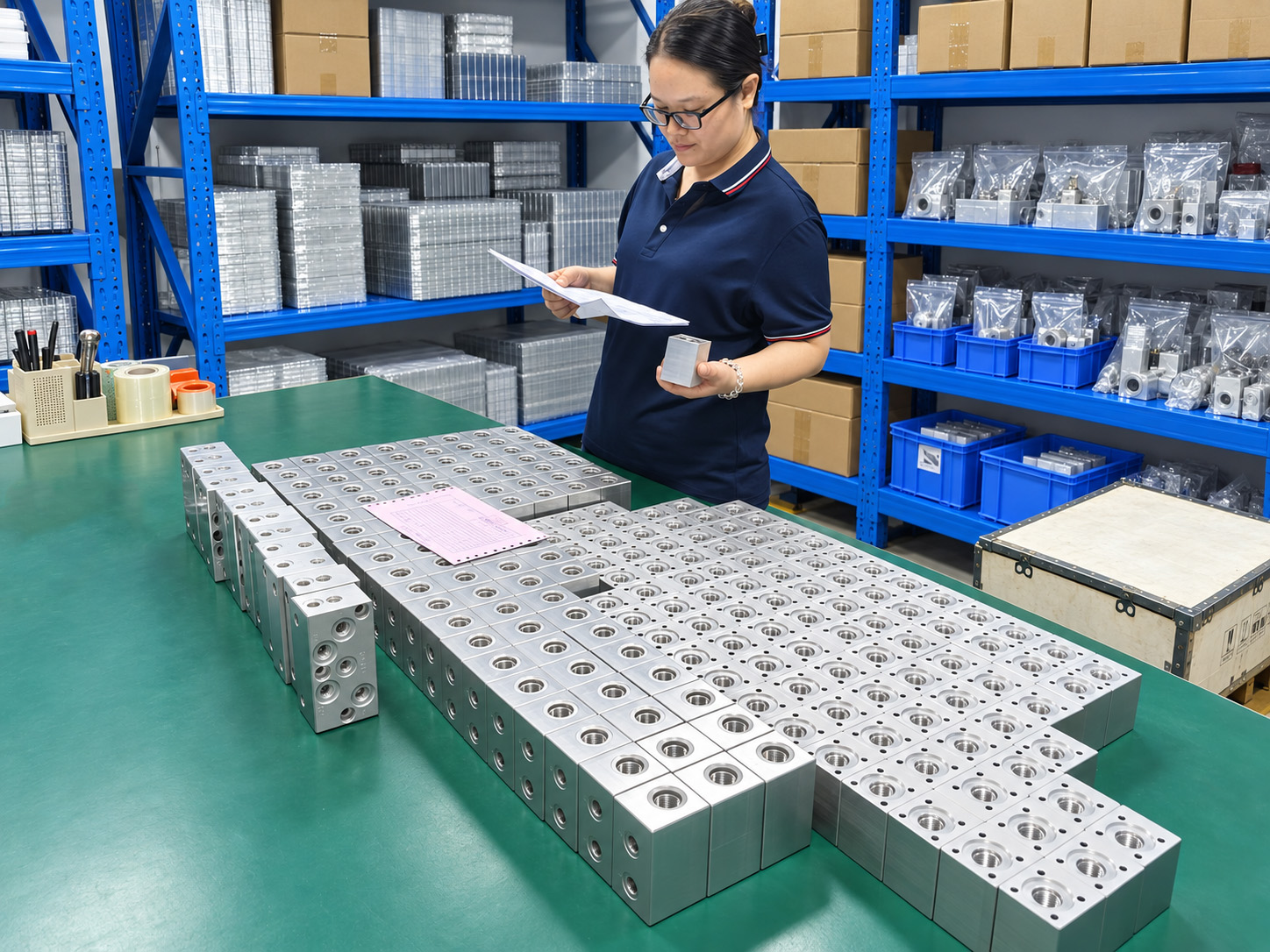
Agree the evidence your receiving team will need
A manifold can arrive with several reports and still leave an incoming inspector unable to answer a basic question: do these records describe the parts in this shipment? Useful documentation connects the requirement, the inspected component and the delivery. More pages do not resolve a missing identification link.
Before the order
Identify the drawing revision, material specification, required reports and any customer forms. Agree which documents are needed for sample approval, shipment release or receipt, so the necessary information can be planned from the start.
During project review
We review the requested package alongside the manufacturing and inspection scope. Document type, feature coverage, sample quantity, identification and delivery timing need to be clear before they become acceptance conditions.
Material certificates and dimensional inspection reports can be supplied. A complete first-article package, specified material certificate type or full CMM report is agreed for the actual project; these are not an automatic set included with every order.
Give each document a defined purpose
Use this planning table to specify the evidence you need. It describes document categories, not a sample report or a claim that every record is available for every material and order.
| Record | What it addresses | What to agree |
|---|---|---|
| Material certificate | The specified material grade and supply condition, supported by the relevant material record. | Required certificate type and the material-to-production identification link. State EN 10204 type 3.1 explicitly when required; availability is confirmed for the chosen supply route. |
| Dimensional inspection report | Results for the identified drawing features and inspected parts. | Drawing revision, feature references, tolerances, inspected quantity and reporting format. Include the specified thread checks, bore geometry and sealing-surface roughness in the agreed inspection scope. |
| First-article and CMM records | An agreed initial inspection package and the features measured using CMM, where applicable. | Which characteristics and samples are covered, how results refer to the drawing, and which checks need separate records. A CMM report alone is not a complete record of every inspection method. |
| Process or finish documentation | Records relating to a specified treatment or process when required by the order. | The relevant process, provider documentation, component coverage and availability. Define these requirements before processing rather than assuming a certificate can be added afterwards. |
| Third-party cleanliness report | The laboratory results for the identified samples and agreed test scope. | Sample identity and condition, method, acceptance criteria and report scope. This is a separate project requirement, not a default delivery document. |
| Delivery identification and document list | The agreed references connecting the shipment, its parts and the accompanying records. | Part and revision references, quantity, batch or package identifiers, and the required file names or document index. Clarify any split shipment or mixed-batch arrangement. |
Normal acceptance of a machined manifold concerns the correct material and conformity to the drawing. Pressure and functional testing are not part of our normal inspection scope, so routine delivery documentation should not imply that those tests have been performed.
See the inspection methods behind the records Review third-party cleanliness reportingDefine how the records will connect to the delivered parts
Material to manufacturing
Where material heat or lot traceability is required, agree the identification link from the material record into the production lot. A material certificate without that link does not, by itself, identify the material in a particular finished block.
Inspection to component
A report needs the applicable drawing revision and an identifiable part or sample set. Agree how the inspected quantity and coverage are stated so a sample record is not mistaken for a result for every component.
Component to shipment
Specify whether identification belongs on the part, its packaging or both. Agree the content, method and location; any part marking must respect the drawing, sealing surfaces and finished condition.
Batch identification and individual serial identification serve different needs. If your project requires each manifold to have its own serial number and linked records, state that before ordering. We review the required traceability level rather than assuming all projects use the same system.
Keep drawing revisions and accepted changes visible
A report checked against an earlier revision can be internally consistent yet fail to answer whether the current order is correct. Establish the approved drawing and model references, including the applicable valve cavity information, before manufacturing and inspection.
When requirements change
Identify the affected features and resolve conflicts between the drawing, model and written instructions. Confirm the agreed revision and any changes to inspection or documentation requirements.
When an exception is proposed
Any proposed deviation needs a clear description, the affected quantity and the customer’s written disposition before release under that exception. The record should distinguish an accepted exception from full conformity to the original requirement.
For an order that includes more than one approved revision or a split shipment, agree how the records and package identification distinguish them. A file name alone is not enough if the document itself refers to a different revision.
Prepare clear drawing and tolerance requirementsSeparate sample approval from repeat-order evidence
First-article inspection supports review of the agreed initial parts and characteristics. It does not automatically establish the condition of all later production. Use the sample stage to agree what will be checked and reported again for repeat deliveries.
At the sample stage
Specify the inspection scope, required customer forms and approval decision. Where feature numbering or an annotated drawing is needed to interpret the results, agree the format before preparing the report.
At the repeat-order stage
Confirm the approved revision, relevant changes and the records required for that order. Define any renewed first-article or additional inspection requirement when the design, material or agreed manufacturing route changes.
Our aim is to give your engineering and receiving teams a usable connection between requirements and evidence. Report format, file delivery, record retention and retrieval requirements should be agreed for the project; do not assume a fixed retention period or a customer document portal.
Plan the transition from samples to productionFour checks before accepting the document package
1. Match the references
Check the part reference, drawing revision and order or delivery reference against the received goods. Resolve discrepancies before treating the reports as evidence for the shipment.
2. Check material coverage
Confirm that the material grade and condition match the requirement, and review the agreed identification link. Similar grade names across standards should not be treated as automatic substitutes.
3. Read the inspection scope
Check the inspected quantity, feature coverage and acceptance basis. Distinguish measured dimensions from gauge or visual checks, and review any stated exclusions or deviations.
4. Check completeness
Compare the supplied files with the agreed document list. Keep relevant report pages and qualifications together; an isolated result image may omit information needed for acceptance.
If something is missing or inconsistent, send the affected document reference and the specific question. We can review the request against the order and available project records. A missing historical test result cannot be replaced by creating a retrospective “pass” statement.
Questions about documentation and traceability
Can you provide material certificates and dimensional reports?
Yes. We can supply material certificates and dimensional inspection reports for the agreed project scope. State the required certificate type, drawing revision, feature coverage and report format during enquiry so these can be confirmed with the order.
Is an EN 10204 type 3.1 certificate included with every order?
No. Specify it when required. We confirm the material supply route and documentation availability for the project. A material certificate also needs the agreed identification link to the supplied parts; it does not replace dimensional inspection.
Does a CMM report cover threads, roughness and burr removal?
Do not infer that from the report title. Review the recorded characteristics and methods. The complete inspection scope may need separate thread-gauge, surface-roughness and burr-removal records alongside appropriate CMM results.
Can you use our inspection form or first-article format?
Send the form and its instructions with the enquiry. We review the requested characteristics, reporting detail and approval requirements before confirming the deliverables. Do not assume a particular industry submission format is included by default.
Can documents be requested after delivery?
We can review what is available for the identified order, but additional documents depend on the records retained and the original inspection scope. New tests, different sample coverage or a missing material identification link cannot be assumed to exist retrospectively.

Include your document requirements with the enquiry
Send the approved drawing revision, material specification, order quantity and required document list. Include any customer report template, first-article scope, material certificate requirement and batch or individual identification instructions.
Tell us when the documents are needed: before sample approval, before shipment or with delivery. State any retention or retrieval requirement so we can confirm a practical scope alongside the manufacturing quotation.
Prepare a complete project enquiry