

304, 316 and 17-4PH for specified manifold projects
Our stainless steel manifold material range includes 304, 316 and 17-4PH. These address different design priorities; the selected grade, supply form and final condition are confirmed against the approved project requirements.
304 stainless steel
An austenitic stainless option where the design calls for 304. We retain that material definition through procurement, cavity machining and inspection, with particular attention to the condition of threads and sealing surfaces.
316 stainless steel
A molybdenum-bearing austenitic grade considered when the environment requires greater resistance to localized corrosion than 304 can offer. Actual suitability depends on the fluid, temperature and exposure; “316” is not a guarantee for every chemical or seawater duty.
17-4PH stainless steel
A precipitation-hardening grade for designs requiring higher strength together with corrosion resistance. Specify its aging condition. Greater strength does not establish better corrosion resistance than 316 or make the grades interchangeable.
304L and 316L appear below as low-carbon references for specification discussions. Their inclusion is not a statement of regular stock or a substitute for confirming the material required for your order.
Compare the grade references before approving a substitution
This table helps engineering and purchasing teams read material designations across markets. It gives comparison references, not unconditional equivalence or a material substitution approval.
| China Grade reference | Europe EN number | US Type / UNS | Relationship and checks |
|---|---|---|---|
| 06Cr19Ni10 | 1.4301 | 304 / UNS S30400 | 304 grade references Compare the specified chemistry limits, product standard and supply condition before approving a cross-standard substitution. |
| 06Cr17Ni12Mo2 | 1.4401 | 316 / UNS S31600 | 316 grade references Retain the molybdenum-bearing grade required by the design. A 304 substitution needs engineering approval. |
| 05Cr17Ni4Cu4Nb | 1.4542 | 17-4PH / Type 630 / UNS S17400 | 17-4PH grade references The grade is only part of the specification. Confirm the required aging condition, mechanical requirements and material certificate. |
| 022Cr19Ni10 | 1.4307; also compare 1.4306 | 304L / UNS S30403 | Low-carbon comparison candidates 1.4306 and 1.4307 are distinct European grades, with different composition limits. Resolve the exact EN grade; a 304L label alone does not make both interchangeable. |
| 022Cr17Ni12Mo2 | 1.4404 | 316L / UNS S31603 | Low-carbon 316L references Shown for specification review, not as an automatic replacement for 316. Check carbon limits, mechanical requirements, condition and certificate basis. |
A type number or UNS identifier is not a complete product specification. Confirm the applicable GB, EN or ASTM product standard, its edition, bar or plate requirements, section size, condition and certificate. Where a drawing uses an EN number, retain that exact number through purchasing.
304L is a useful example of why the detail matters: European references include distinct 1.4306 and 1.4307 grades. The required composition and product specification must resolve the choice; do not treat every 304L-labelled bar as the same material.
Grade references: Baosteel stainless steel grade comparison; Outokumpu stainless bar grade references. Supplier tables help identify candidates; the approved specification and material certificate govern the order.
Separate the working fluid from the outside environment
A manifold on offshore equipment may carry hydraulic oil internally while its outside faces encounter salt-laden moisture. A block carrying a chemical process fluid faces a different exposure. Describing either project only as “marine” or “chemical” leaves important material-selection questions unanswered.
Inside the passages
Identify the actual fluid, concentration where relevant, temperature and contaminants. Include any flushing or cleaning fluids that will contact the block. The responsible engineer uses these conditions alongside the pressure duty and geometry to specify the material.
Outside the block
Distinguish sheltered installation, washdown, salt spray and immersion. Crevices, deposits and contact with other materials also affect exposure. A salt-spray requirement does not establish suitability for continuous seawater immersion.
We review how the approved choice affects stock procurement, machining, surface treatment and delivery records. Material selection and the component pressure design remain with the responsible design engineer; there is no universal pressure rating attached to a stainless grade name.
Corrosion context: Outokumpu guidance on corrosion mechanisms and exposure. Project-specific compatibility requires the actual service conditions.
Review the full material-selection questionsSpecify the condition as carefully as the grade
304 and 316: define the supplied stock
Record the product form and specified delivery condition, including any cold-worked condition or mechanical-property requirement. The purchasing definition and material record provide the starting point for selecting tooling and planning the machining sequence.
17-4PH: retain the aging designation
H900 and H1150 are different conditions, not alternative spellings of 17-4PH. Agree the required final state, treatment sequence and records before machining. An unaged Condition A blank does not establish compliance with an aged final-part requirement.
Inspect the final required condition
Where treatment follows machining, plan finishing allowances and the checks needed after treatment. Critical dimensions, threads and sealing surfaces need to meet the drawing in the agreed delivery condition, not merely at an earlier stage.
17-4PH reference: Carpenter Custom 630 / 17-4PH material data. Condition-dependent properties must be read against the specified product and project requirements.
Connect material and treatment recordsMake the cavity conform, even when the material is harder to machine
The customer needs a valve interface that meets the drawing, not simply a stainless block with drilled holes. In 304 and 316, chip control, built-up edge and surface damage can complicate finishing. For 17-4PH, the specified condition changes the cutting demands. Our manufacturing review connects those risks to the actual features that must be accepted.
Cavity steps and sealing bores
We work from the exact valve model and current cavity drawing, reviewing steps, depths, diameters and sealing transitions together. Dedicated cavity tooling and non-standard tool development support the required geometry. Tool condition and finishing allowance are part of maintaining the surface.
Thread quality and entry edges
A damaged entry or residual burr can obstruct assembly even when the nominal thread designation is correct. We address the usable thread, entry condition and intersecting features during machining, then check the specified thread with suitable gauges.
Deep and intersecting passages
Chip evacuation and access for later deburring need attention before the passage is complete. We review cross-hole locations and machining order so the route for removing chips and addressing intersection burrs is part of the process plan.
Evidence at the critical features
Drawing requirements define what is measured: bore diameter, location, specified geometric tolerances and sealing-surface roughness. A bright surface is not a roughness result, and a thread-gauge pass does not verify the whole valve cavity.
For repeat production, controlled drawings, tooling condition and relevant inspection checkpoints connect the approved sample to later batches. We do not assign one blanket tolerance or surface-roughness value to every stainless feature.
Machining context: Sandvik Coromant guidance for stainless steel cutting. Cutting tools and conditions are selected for the actual operation.
Dedicated and custom valve cavity tooling Screw-in cartridge valve manifold requirementsDeburring, cleaning and passivation answer different questions
Are the edges and passages ready?
Controlled deburring addresses intersections, thread exits and cavity edges without damaging the intended geometry. Cleaning then removes machining residues and loosened particles. The route must include the internal passages, not just the visible outer faces.
Is chemical passivation specified?
Where required, agree the treatment standard, method and acceptance criteria with the project. Passivation addresses surface contamination and the passive surface condition; it does not remove a machining burr, prove particle cleanliness or turn the wrong alloy into a suitable one.
Will the delivery condition be preserved?
Plan handling and packaging around the cleaned component and agreed surface requirements. Protect openings and critical surfaces from recontamination or damage. Any requirement for surface-contamination testing needs an agreed method and record.
If formal component cleanliness evidence is required, define the method, sample and limits. Zhongwei can coordinate project-specific third-party SGS testing to ISO 16232. This is separate from routine cleaning and from any agreed passivation acceptance checks.
Passivation reference: ASTM A967/A967M — chemical passivation treatments. Specify the applicable treatment and acceptance provisions for the project.
Deburring, cleaning and packaging Third-party component cleanliness verificationVerify the material and the features on the drawing
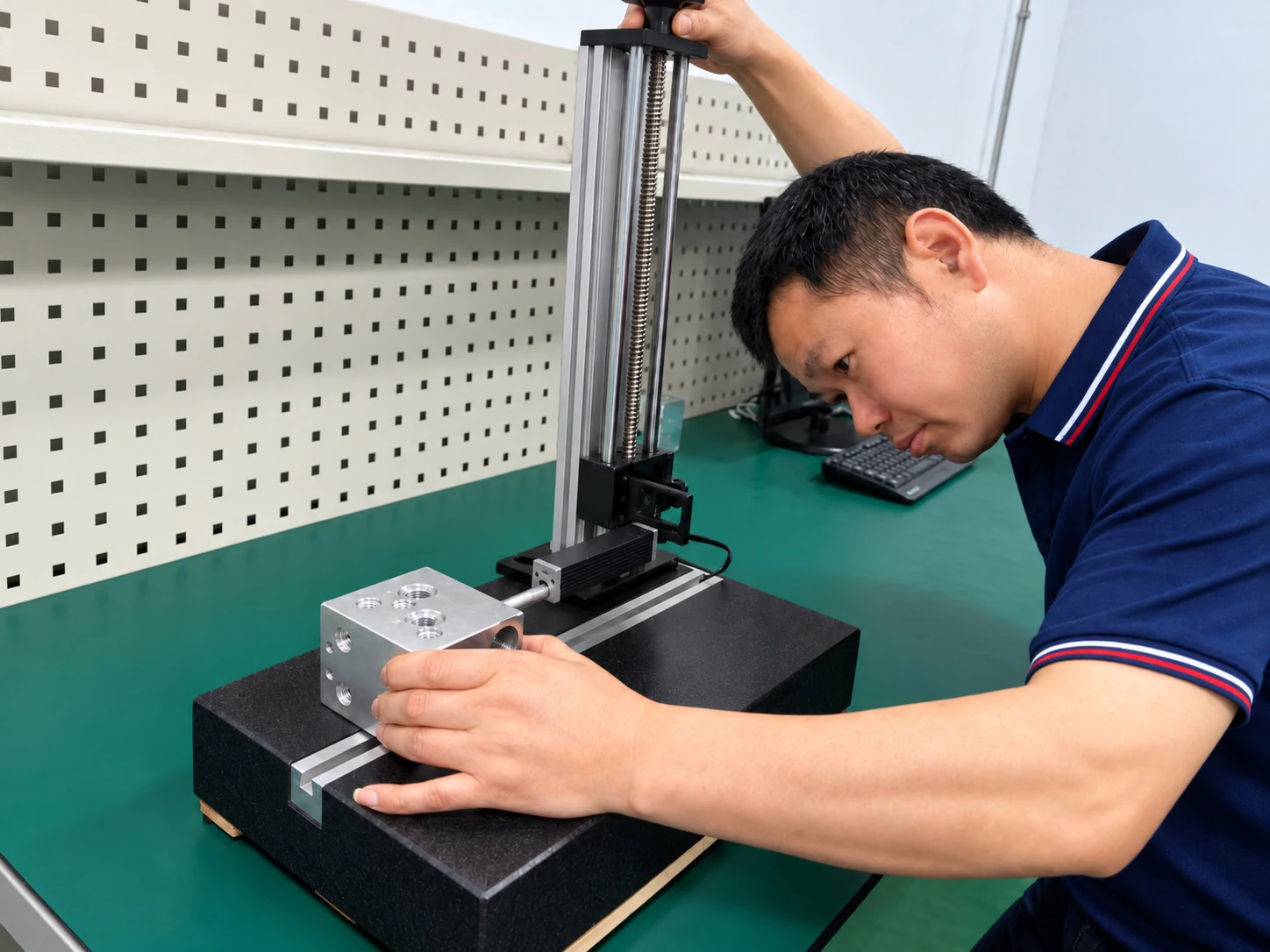
A material record that matches the part
Check the specified grade and condition against the agreed material documentation and batch identity. Material certificates and dimensional reports can be provided. Agree any additional material verification, heat-treatment record or EN 10204 3.1 requirement before the order is released.
A report that answers the drawing
Inspection addresses dimensions, thread-gauge conformity, bore diameter and specified concentricity, coaxiality or roundness, sealing-surface roughness and burr removal. The method and report coverage must fit the feature; CMM measurement does not replace every other check.
Machined manifold blocks are normally supplied without pressure or functional testing. Our normal acceptance work verifies the material and drawing conformity; it does not validate the performance of an assembled hydraulic circuit.
Inspection methods and acceptance scope Delivery documents and traceabilityQuestions about stainless steel manifold manufacture
Which stainless steels can I specify for a Zhongwei manifold?
Our stated range includes 304, 316 and 17-4PH. Confirm the full grade, product standard, supply form, required condition and documentation for the order. 304L and 316L are included in the comparison table for specification review; availability and project suitability require confirmation.
Can a Chinese grade replace the European or US grade on my drawing?
Use the table to identify a comparison candidate, then compare the actual chemistry limits, product requirements, condition and certificate. The responsible engineer must approve any substitution. Similar names or a supplier cross-reference alone do not authorize a material change.
Is 316 automatically suitable for seawater or chemical service?
No. Specify the actual fluid and external exposure, temperature, concentration where relevant, and service conditions. The design engineer determines suitability. “Offshore equipment” can describe very different exposure conditions.
Does 17-4PH need a heat-treatment condition on the drawing?
Yes. Retain the exact aging condition and required final properties. It affects the material definition, manufacturing sequence and acceptance records. The final dimensions must be verified in the agreed delivery condition.
Do 304 and 304L mean the same material?
No. The L designation identifies a low-carbon variant. Compare the complete specification and certificate; use dual certification only when the supplied material record actually supports both specifications. The same principle applies to 316 and 316L.
Does passivation replace deburring or a cleanliness report?
No. They address different requirements. Deburring removes unwanted edges, cleaning addresses residues and particles, and specified passivation addresses the surface condition. Formal cleanliness or passivation acceptance needs its own defined verification basis.
How do you check a stainless valve cavity?
Use the controlled cavity drawing to identify the required dimensions, threads, geometry and surface finish. Apply suitable measurement methods and thread gauges to those features, with report coverage agreed for the project. A single gauge or photograph cannot verify the complete cavity.
Can we begin with a schematic?
Yes. Send the hydraulic schematic with the valve list, operating conditions and installation constraints. Complete manifold drawings are preferred. The material, interfaces and manufacturing definition need approval before production.
Share the drawing, material condition and service requirements
Send the drawing revision and 3D model if available, exact material specification and condition, valve models and cavity drawings. Include critical sealing surfaces, thread and geometric requirements, any passivation specification and the required inspection records.
Add the working fluid, temperature, external exposure, sample and production quantities. We accept DWG, DXF, PDF and JPG drawings, and STEP, X_T, IGS and SLDPRT models by email or WhatsApp. A schematic and valve list can start the discussion.
Prepare a manifold project enquiry