
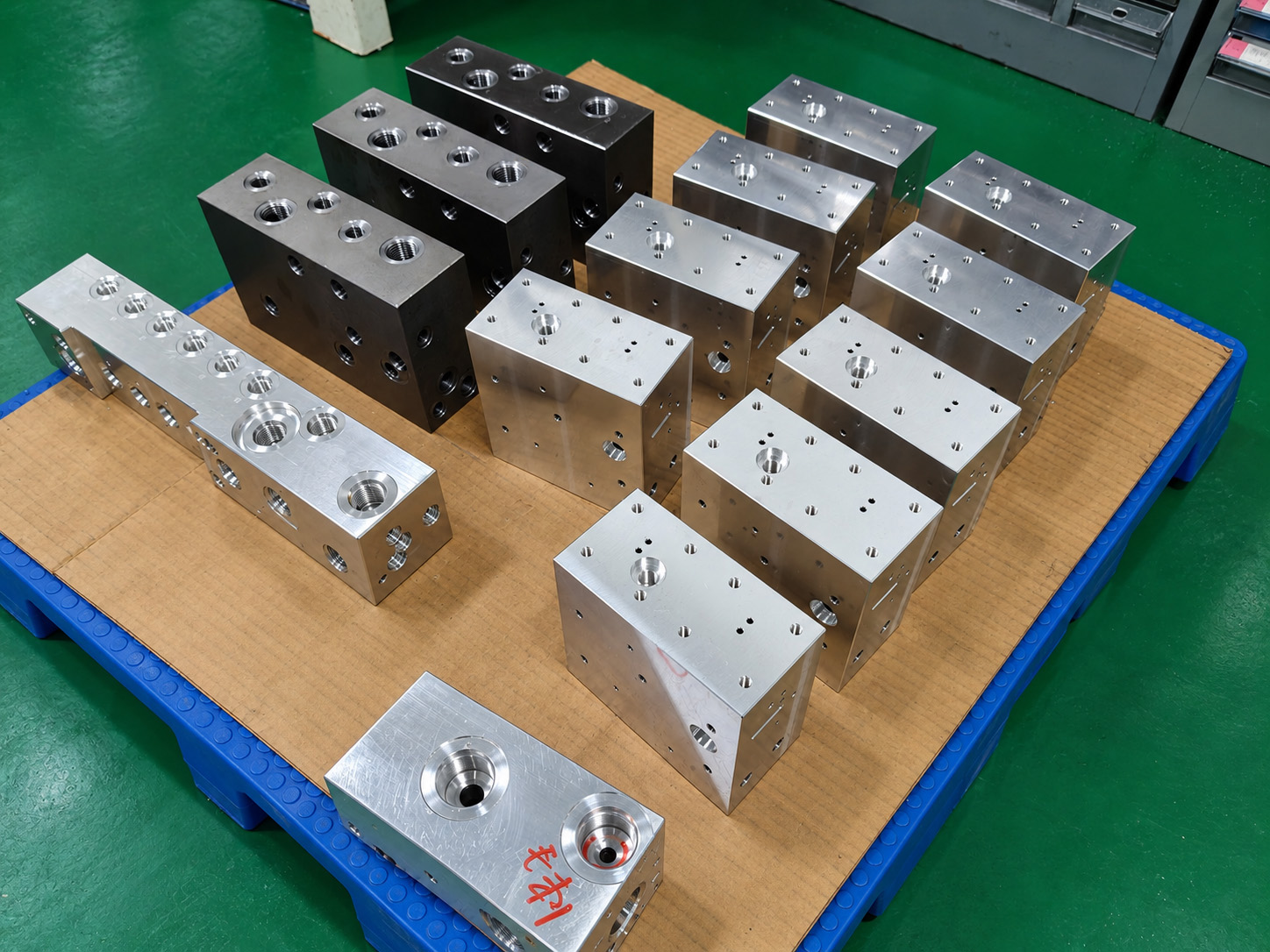
Start with where and why protection is needed
A note such as “anti-rust” or “black finish” does not tell a processor which surfaces are critical or what the finished manifold must meet. Separate the protection objective from appearance, and connect both to the material and final drawing requirements.
Outside the manifold
Describe indoor storage, outdoor exposure, splash, process chemicals or other actual conditions. Include handling and transport where relevant. A general industry label leaves important exposure details unresolved.
Inside the passages
Identify passages requiring protection during storage, shipment or service. Include the working fluid and any compatibility restrictions. Deep holes and blind intersections need their own coverage and drainage review.
At functional interfaces
Mark valve cavities, threads, sealing lands, mounting faces and grooves. Define their accepted dimensions and surface condition after treatment so protection does not compromise assembly.
Zhongwei reviews these requirements with the machining route and processing supplier. The design owner approves the selected finish and any changes to functional requirements.
Connect the finish to material selectionCompare treatment routes by the requirement they must meet
The table is a selection discussion, not a best-to-worst ranking. Performance depends on the substrate, preparation, coating system, geometry and exposure. Confirm the proposed route with the approved project specification.
| Treatment route | Why it may be considered | Conditions to resolve before approval |
|---|---|---|
| Black oxide (blackening) | A conversion finish for specified steel surfaces and dark appearance, commonly used with supplementary protective oil. | Agree the process and oil or seal, corrosion requirement and compatible handling. Black color alone is not a finish specification; do not infer outdoor life or internal protection from appearance. |
| Phosphating (phosphate conversion coating) | A conversion-treatment option for steel where the project calls for a phosphate surface and its specified follow-on protection. | Identify the phosphate type, surface requirements and any supplementary oil or sealer. Control preparation, residues and final functional surfaces; do not assume one phosphate process suits every cavity or fluid. |
| Aluminum anodizing | An oxide finish for the specified protection, appearance or surface-function requirement on an approved aluminum alloy. | Define the type, thickness requirement, sealing and color where applicable. Review alloy response, final dimensions and protected features; “black” alone is not a complete specification. |
| Electroless nickel | A candidate for coating complex surfaces and internal passages where solution access supports deposition. | Specify the coating system and required characteristics. Check internal access, thickness locations and final fit; uniformity on an accessible surface does not prove every hidden region is covered. |
| Zinc electroplating | A steel protection option with the supplementary finish and performance required by the project. | External protection does not establish coverage deep inside the block. Review material condition, thickness distribution, post-treatment and the final thread or sealing requirements. |
| Zinc-nickel electroplating | A candidate for steel projects with demanding external corrosion-protection requirements. | Assess the full coating system and evidence for the application. Internal recess coverage still needs review; the process name does not establish a universal corrosion lifetime. |
| Electroless nickel plus zinc | A project-specific combination considered when internal passage protection and external protection need different attention. | Agree the layer sequence, coverage, compatibility, total dimensional effect and acceptance. This is an option in Zhongwei’s project experience, not the default treatment for every steel block. |
A specified stainless steel passivation process, or temporary preservation for shipment, needs its own requirements. Neither should be substituted for a required deposited coating without approval. Availability and processing scope are confirmed for the actual part.
Reference: Birchwood Technologies: black oxide finishes. Black oxide is commonly paired with a suitable oil for corrosion protection.
Reference: Henkel: phosphate conversion coatings. The selected phosphate system and subsequent finish need their own specification; this is process background, not a supplier relationship or a Zhongwei test result.
How Zhongwei manages the approved treatment routeWhen the next operation is welding: preserve the machined surface
For our Q355B and GB 45 valve-integrated cylinder ends and cylinder-head valve blocks intended for welding, the delivery route is machining followed by immersion in a no-clean rust-preventive oil and packing in a sealed, dust-protective PE bag. These components do not require plating, black oxide or phosphating for this supply route.
The no-clean rust-preventive oil used by Zhongwei allows welding without a separate cleaning or degreasing step to remove the protective oil. Here, no-clean refers to the subsequent welding operation. Confirm the preservation route against the customer’s welding procedure; this statement does not apply to other protective oils or remove other weld-preparation requirements.
Zhongwei uses approximately 3–6 months as an experience-based reference for this preservation route, subject to packaging and storage conditions. Dry storage helps maintain protection; moisture exposure, handling and damage to the bag or oil film can change the outcome. Agree the storage and transport requirements for the order rather than treating this reference as an unconditional rust-free period.
Customer feedback reported to Zhongwei describes parts protected with this oil and sealed in dust-protective PE bags that showed no rust after approximately one month of sea transport followed by more than one month in a warehouse. This is delivery experience for those conditions, not a controlled corrosion test or a guarantee for every shipment.
Cylinder-end materials and delivery conditionThe outside of the block cannot prove the condition inside it
With electroplated zinc or zinc-nickel, current distribution can make deep recesses more difficult to coat than exposed faces. A satisfactory exterior therefore cannot be taken as evidence of equivalent protection in every internal passage.
Why electroless nickel is considered
Electroless nickel uses chemical deposition rather than an externally applied plating current. It can provide more uniform coverage on complex shapes when fresh solution reaches the surfaces. Deep passages still need an assessment of solution circulation, trapped gas and subsequent rinsing.
What to define on the drawing
Identify the actual internal surfaces that need protection and the required acceptance evidence. Agree how inaccessible areas will be assessed, and whether a representative sample or other project-specific method is necessary.
What the combination route must resolve
If electroless nickel plus zinc is proposed, define which layer serves each surface, the sequence and final dimensions. An additional layer does not remove the need to verify coverage or compatibility.
Reference: ASTM B733 electroless nickel-phosphorus coating overview. The overview links coating uniformity to free circulation of the plating solution. It does not guarantee coverage in an unassessed manifold geometry.
Protection also depends on what happens after processing. Consider trapped residues, drying, compatible preservation and clean packaging, particularly when a block will spend time in storage or transport.
Cleaning and preservation of internal passagesKeep coating thickness, roughness and final size separate

Coating thickness describes the layer
It addresses the applied or formed surface layer at specified locations. Identify the required range and measurement basis. Do not infer hidden thickness from a visible surface or an external reading.
Surface roughness describes the texture
An Ra requirement belongs to an identified surface and inspection stage. A smooth-looking coating does not prove that a valve sealing land meets its roughness requirement.
Final diameter, thread fit and mating geometry are separate acceptance requirements. Plating build-up and anodizing-related dimensional changes must be accounted for in the approved process plan. Do not apply one machining allowance to every finish or feature.
Masking is a design and process decision: it preserves an untreated area but may leave that area needing another protection strategy. Likewise, machining or re-tapping after coating removes material from the treated feature and needs an approved rework or finishing route.
Reference: Aluminum Anodizers Council process FAQ. Anodizing and associated preparation can affect dimensions; assess the complete process for the actual feature.
Match each requirement to its inspection methodMaterial condition changes the finishing decision
Aluminum and appearance
Alloy, temper and preparation influence anodized appearance. For 2017, 2024 and 7075, Zhongwei works with processing suppliers to improve consistency. Agree representative samples and an acceptable range; completely identical color or freedom from visible material variation is not a blanket promise.
Steel strength and hydrogen risk
For steels such as C35E+QT or 4140 in a specified high-strength condition, review hydrogen-embrittlement risk with the material state and finishing specification. Agree pretreatment, any required relief treatment, sequence and records with the processor.
Welding and later operations
Identify any welding, heat treatment or final machining planned after the finish. The route must account for the condition in which critical surfaces are finally accepted, rather than assuming the coating will remain unaffected.
A stronger base material, a harder coating or a thicker layer is not automatically the right solution. Confirm the desired function together with fit, sealing, corrosion exposure and the approved material condition.
Reference: Aluminum Anodizers Council specification guidance. Alloy and temper influence finish selection and appearance.
Reference: ASTM B850 post-coating treatment guidance. Relief treatment is a risk-reduction measure; it is not a guarantee that hydrogen-related effects are impossible.
Aluminum grades and anodizing considerations Weld-intended cylinder-end blocksWrite a finish requirement that can be quoted and inspected
Use these six items to identify what is already specified and what needs an engineering decision. Unresolved requirements should remain visible during quotation, rather than being filled in by assumption.
| Requirement | What to state | Decision it supports |
|---|---|---|
| Substrate and condition | Exact material, applicable condition, relevant hardness and any planned thermal or welding operations. | Resolve material-sensitive processing requirements before selecting the finish. |
| Process definition | Treatment specification and revision; type or class where applicable; thickness and any supplementary treatment. | A color or commercial process name alone leaves performance and acceptance unclear. |
| Coverage and masking | Coated surfaces, protected areas, internal coverage needs, masking boundaries and permitted contact locations. | Different surfaces may need different protection and acceptance requirements. |
| Functional requirements | Final dimensions, thread acceptance, sealing-surface roughness and any permitted finishing after treatment. | The delivered condition must meet the part drawing, not just the coating description. |
| Appearance and exposure | Relevant environment, appearance reference, acceptable variation and important viewing surfaces. | Separates visual acceptance from the corrosion and functional requirements. |
| Evidence and delivery | Required test method, sample scope, acceptance criteria, processing records, cleaning and packaging condition. | Defines what evidence the order needs and what each record represents. |
For example, “black finish” can be expanded into an approved process specification, identified treated surfaces, final dimensions, appearance reference and required records. The actual type, thickness and limits must come from the agreed design requirements; this guide does not prescribe universal values.
From approved specification to supplier handoverRead test results within their actual scope
Appearance and thickness
A visual check addresses the defined appearance. Thickness evidence must identify its method and locations. Neither alone proves all internal coverage, adhesion or in-service corrosion behaviour.
Salt-spray evidence
If requested, define the test method, duration, specimen or part scope and the failure criteria. Results relate to those conditions; salt-spray hours cannot be converted directly into years of service or used as a universal ranking of materials.
Part acceptance and records
Connect processing records and agreed tests to the relevant part or sample. Confirm final dimensions, threads, specified roughness and clean delivery separately. Ask what a coupon represents before treating its result as evidence for a hidden passage.
Reference: ISO 9227 salt-spray test overview. The standard describes controlled corrosion testing and explicitly limits its use for predicting long-term corrosion resistance or ranking different materials.
No fixed salt-spray duration, universal service life or automatic test-report package is promised here. Testing and documentation follow the project’s agreed scope. Pressure and functional testing are not routine checks for the machined manifold block.
Link records to the delivered partsQuestions about choosing a manifold finish
Are black oxide and phosphating options for steel manifolds?
Yes. Both can be specified for suitable steel manifold projects. Define the exact process, supplementary protection, treated surfaces and acceptance requirements. They are not default treatments for the Q355B and GB 45 cylinder ends supplied for welding.
Does every steel component need a permanent surface treatment?
For our Q355B and GB 45 valve-integrated cylinder ends and cylinder-head valve blocks intended for welding, the delivery route is machining followed by immersion in a no-clean rust-preventive oil and packing in a sealed, dust-protective PE bag. These components do not require plating, black oxide or phosphating for this supply route.
Does a coated exterior mean that every deep passage is protected?
No. Internal coverage depends on the process, geometry and access. Specify the required internal protection and agree suitable evidence; an outside appearance or thickness check alone is insufficient.
Should I choose zinc-nickel instead of electroless nickel?
Start with the protection locations, environment, substrate condition and final dimensional requirements. Zinc-nickel and electroless nickel address different processing considerations; neither is a universal replacement for the other.
Is electroless nickel plus zinc always necessary?
No. It is a project-specific option when internal and external protection requirements justify reviewing a combined route. Agree its sequence, layer requirements, compatibility and final acceptance before approval.
Does a smooth-looking coating prove the sealing-surface Ra?
No. Appearance and roughness are different characteristics. Identify the sealing surface, specified limit, final condition and appropriate measurement method.
Can a thicker coating improve protection without affecting the drawing?
Do not assume so. Thickness and preparation can affect final sizes, threads and mating features. Any change to the specified finish needs review against the functional drawing requirements.
Can all aluminum grades have the same black anodized appearance?
Do not assume identical results across alloys or material conditions. Review representative samples and agree the acceptable appearance range for the relevant surfaces.
Does a salt-spray result establish outdoor service life?
No. The test provides evidence under its defined laboratory conditions and acceptance criteria. Real service also depends on exposure, geometry, damage, handling and other application conditions.
What if our drawing only says anti-rust treatment?
Identify the material, environment, surfaces requiring protection, final dimensions and evidence needed. Zhongwei can review the manufacturing implications with the processor; the selected treatment and requirements need approval before release.
Share the finish objective with the part drawing
Include the material and condition, operating and storage environment, current finish note, internal protection needs, sealing and threaded features, final tolerances and required records. If there is an existing concern, identify whether it is internal rust, external corrosion, appearance or fit after treatment.
Send DWG, DXF, PDF or JPG drawings and STEP, X_T, IGS or SLDPRT models by email or WhatsApp. Complete manifold drawings are preferred; a schematic can start the discussion. The treatment route needs an approved part definition and finish requirements before processing.
Prepare the project enquiry